
A quiet earthquake just happened in the world of learning disabilities — and most people missed it.
The International Dyslexia Association (IDA) updated its definition of dyslexia for the first time in more than 20 years. The change seems subtle on the surface, but its implications are enormous.
Education Week recently reported on this shift in an article titled “What a New Dyslexia Definition Could Mean for Schools” (Nov. 24, 2025). The key update?
IDA removed language describing dyslexia as “unexpected” relative to a child’s intelligence.
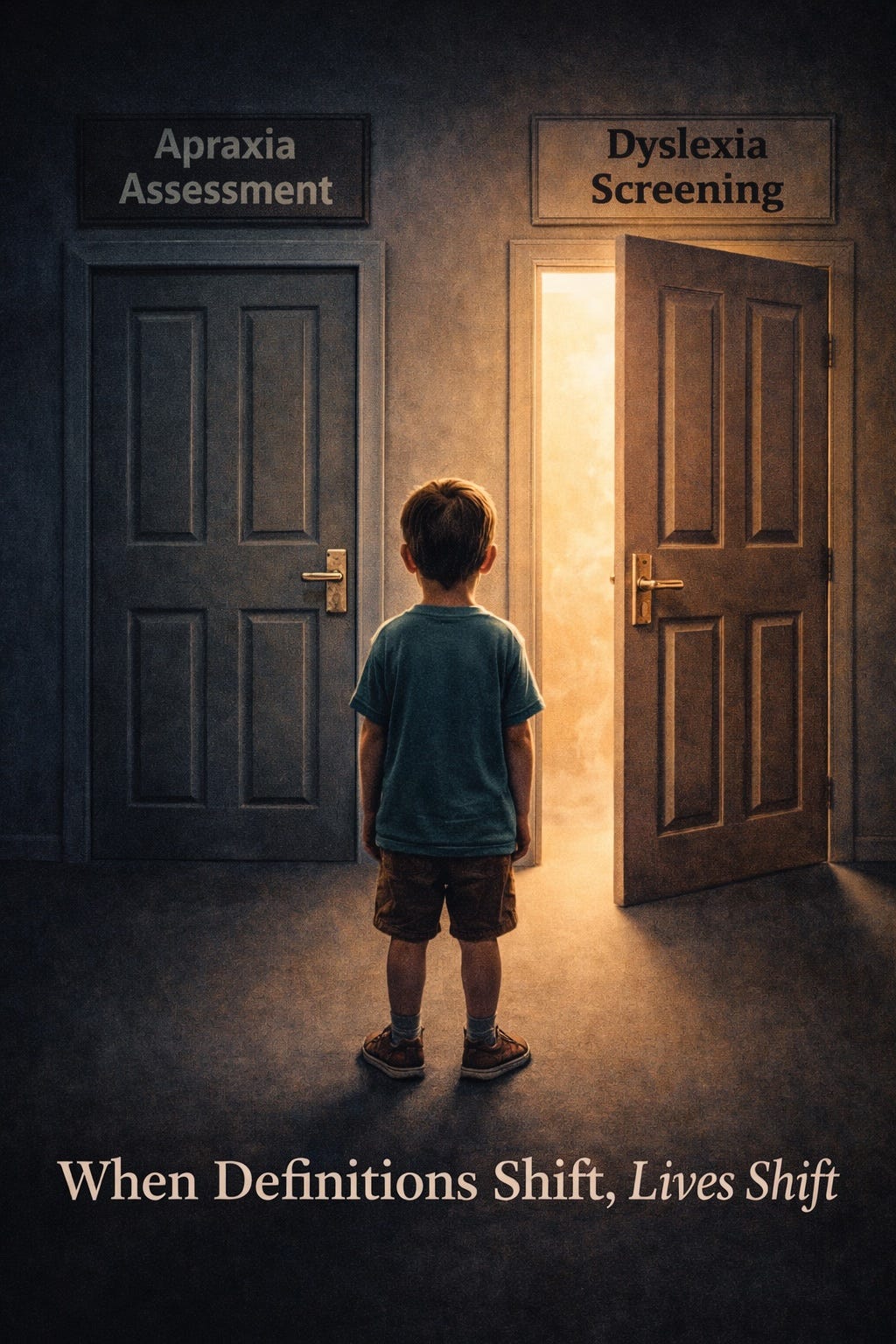
To most readers, that might feel like academic housekeeping — a technical tweak buried in professional journals.
But watch what happens when you remove that single word.
The old definition required a gap between IQ and reading ability. Schools would test both, and if the gap was big enough (if you seemed “smart” but read poorly) you got services. But if there wasn’t a large gap? If both scores were lower? Schools would say your reading matched your intelligence, so it wasn’t dyslexia. You were “just a slow learner.”
Here’s the problem: Children from lower-income families, English learners, and children of color often scored lower on IQ tests not because they weren’t intelligent, but because the tests themselves were biased, because they lacked early educational resources, or because the tests measured cultural knowledge rather than actual cognitive ability.
These children had dyslexia — but were systematically denied services because they couldn’t clear an arbitrary IQ threshold that had nothing to do with whether they actually had the condition.
As Devin Kearns, professor of early literacy at NC State, explained: “The idea of having this cut point of a discrepancy really misrepresents the way dyslexia works.”
Translation: The field outgrew the model. The science outgrew the model. And finally, the policy is catching up.
This shift matters because it establishes something crucial: When a definition harms children, we have an obligation to change it.
Which brings us to the next frontier in disability justice that almost no one is talking about.
Apraxia.
⸻
The Numbers That Should Alarm Every Parent and Educator
First, let’s be clear about what we’re discussing: Apraxia (and its related condition dyspraxia) refers to neurobiological motor-planning disorders that profoundly impact a person’s ability to speak, sequence movements, and reliably express what they know. While the terms have technical distinctions, they describe a spectrum of challenges in planning and executing voluntary movements despite having the physical capability to do so.
This isn’t just about speech. Apraxia creates a brain-body disconnect that can affect a child’s ability to point to answers on a multiple-choice test, raise their hand, navigate a communication device, or perform any task requiring planned, sequenced movements — even when they know exactly what they want to do. In the context of speech, this is often called Childhood Apraxia of Speech (CAS).
Here’s what we know about apraxia in autistic children:
Research suggests that 30-40% of autistic individuals have apraxia — a condition that fundamentally affects their ability to communicate and demonstrate what they know.
Read that again: 30-40%.
Now consider this: In 34 states, schools are required to screen for dyslexia, which affects roughly 5-15% of the general population.
Apraxia screening for autistic children — a population where the condition may affect nearly half of all individuals?
Required in zero states.
Not rarely screened. Not inconsistently screened. Never screened.
Picture a classroom with 20 students. Two are autistic. There’s a strong probability that one of them has apraxia that no educator will identify, no IEP team will address, and no intervention will target.
That child will instead be interpreted as:
- intellectually disabled
- non-compliant
- behaviorally challenging
- “not ready” for literacy
- “not capable” of academic education
And because apraxia isn’t identified, that child will be denied access to age-appropriate instruction, robust AAC, spelling-based communication methods, and even the basic dignity of being presumed competent.
This isn’t a mismatch between a child and their curriculum.
When nearly half of a population has a condition that fundamentally affects how they’re educated, and we systematically refuse to identify it — that’s not an oversight.
That’s a civil rights violation.
⸻
What Happens When We Miss Apraxia: One Family’s Story
My family lived this reality for years.
My son Stone is autistic and has apraxia. But we didn’t know the second part for most of his childhood.
We did years of speech therapy targeting the wrong thing. Years of ABA trying to “shape” behavior that was actually a motor-planning disorder. Years of professionals telling us Stone “wasn’t ready,” “wasn’t trying,” or “didn’t understand.”
None of it worked. Not because Stone wasn’t capable. But because every intervention was based on a fundamental misunderstanding of what was actually happening in his body.
The apraxia didn’t just affect his speech — it affected his ability to reliably point, to consistently perform movements on command, to demonstrate his knowledge through any motor-based task. Teachers would ask him multiple-choice questions and when he couldn’t point reliably to answers, they assumed he didn’t know them. The disconnect between his mind and his body’s ability to execute planned movements was invisible to everyone evaluating him.
And here’s the cruel irony: apraxia doesn’t just affect speech. It can also impact the motor planning needed to use many AAC devices. So children are given communication tools they can’t motorically access, struggle to use them, and are then labeled as “failing AAC” — when what actually failed was our understanding of their motor needs.
Without apraxia screening, teams can’t match communication methods to a child’s actual motor profile. A child who could succeed with eye gaze technology or a letterboard gets handed a device requiring complex navigation and precise selections. When they struggle, the conclusion isn’t “wrong tool” – it’s “this child can’t communicate.”
It wasn’t until Stone was nearly 17 years old — when he finally accessed a motor-based spelling method — that everything changed.
His mind poured out.
Poetry. Philosophy. Literary analysis. Observations about the world that were years beyond what any professional had assumed he could think.
He went from being seen as a non-speaking child with “global delay” to being honored as Student of the Month from our local Edmonds Rotary Club.
All because the school system never recognized his apraxia.
Not in elementary school, when early intervention could have changed everything. Not in high school, when he sat in life skills classes learning to sort coins while his mind hungered for real academics. Not until he was nearly grown.
The window we lost can never be recovered. But the pattern that stole those years from us is still stealing them from millions of children right now.
⸻
The Same Logic, Higher Stakes
The dyslexia field had to confront a painful truth: Its diagnostic model was excluding many of the very children it was supposed to serve.
The autism and apraxia fields need the same reckoning.
For decades, schools have used a speech-centric model to determine:
- intelligence
- academic placement
- communication access
- literacy instruction
- educational potential
But here’s what that model misses entirely:
Speech is a motor skill. It is not a measure of cognition.
The failure to separate these two things — the ability to plan and execute speech movements versus the ability to think, understand, and learn — is how entire generations of autistic nonspeakers have been miseducated, underestimated, and silenced.
When IDA removed the “unexpected” language from its dyslexia definition, it created a policy precedent: Definitions must evolve when the old ones cause harm.
Dyslexia affects reading. Apraxia affects the ability to communicate your mind at all.
If we needed a policy shift for one, we desperately need it for the other.
⸻
What Apraxia Screening Could Look Like
The dyslexia screening infrastructure already shows us the model.
Screeners don’t diagnose, they identify risk. They catch children early so schools can intervene appropriately, notify families, and provide evidence-based support. This is considered standard, responsible education policy.
For apraxia, screening would look for known motor markers:
- Inconsistent speech sound errors
- Difficulty sequencing movements
- Gaps between receptive language and expressive ability
- Motor planning challenges beyond speech
- Unreliable or inconsistent responses to motor-based tasks
Just as dyslexia screening triggers specific supports, apraxia screening should trigger:
Immediate access to:
- Motor-appropriate AAC systems — Because apraxia affects motor planning, many standard AAC devices that require complex navigation, multiple touches, or precise selections may be inaccessible. Screening allows teams to match communication methods to the child’s actual motor capabilities, whether that’s single-switch scanning, eye gaze technology, or direct selection with appropriate accommodations.
- Motor-based communication methods (letterboards, typing, spelling supports) that bypass sequenced motor demands
- Trained communication partners who understand how to support motor-planning challenges during AAC use
- Age-appropriate academic instruction regardless of speech ability
- Assessment methods that don’t rely on untrained motor responses to demonstrate knowledge
Protection from:
- Assumptions of intellectual disability based on speech output or unreliable motor responses
- Placement in restrictive settings due to motor challenges
- Denial of literacy instruction
- Years of ineffective speech-only interventions
None of this is radical. We already do it for dyslexia.
The question is: Why don’t we do it for a condition that’s potentially three times more prevalent in the population it affects?
⸻
A Shift Has Begun — It’s Time to Move With It
Dyslexia advocates spent decades pushing the scientific community and policymakers to update an outdated definition.
They succeeded because they made the harm undeniable. They succeeded because they showed the disparity was structural, not individual. They succeeded because they demanded that policy catch up with science.
The same opportunity is in front of us now.
The science on apraxia exists. The prevalence data is clear. The harm of not screening is documented in thousands of miseducated lives. And the policy template — mandatory screening, parent notification, evidence-based intervention — already exists.
Our son is proof of what becomes possible when apraxia is finally recognized. Tens of thousands of nonspeakers finding their voices through spelling are proof. Every child sitting in a life skills classroom without access to age-appropriate academics right now with unidentified apraxia is proof of what we’re still getting wrong.
⸻
The Pebble and the Ripples
This is where change begins — with a single clear position:
Every autistic child should be screened for apraxia within the first year of identification.
Just as dyslexia screening protects a child’s right to read, apraxia screening protects a child’s right to communicate.
If you’re a parent: Talk to your child’s IEP team about apraxia screening. If they don’t have a protocol, ask if they can create it. Request motor-based communication assessment. Demand access to spelling methods and robust AAC that unlocks these minds.
If you’re an educator: Learn the signs of apraxia. Question assumptions about cognition based on speech output. Advocate for screening protocols in your district.
If you’re a policymaker: Look at what 34 states have done for dyslexia. Apply that same framework to apraxia for autistic students. The research supports it. The need is urgent.
This is the pebble.
When definitions shift, practice shifts. When practice shifts, lives shift.
Now we let the ripples move outward.
David Kaufer is a digital marketing strategist, autism advocate, and host of “The Lighter Side of the Spectrum” podcast. His work focuses on communication rights, motor-based communication methods, and challenging assumptions about intelligence in nonspeaking individuals.