
When Temple Grandin speaks, people listen.
And for good reason.
She’s one of the most important voices we’ve ever had in the world of autism – a living testament to the beauty of neurodivergent minds and the power of being seen, supported, and taken seriously.
In her recent NBC News interview, Temple offered a wide-ranging reflection on how autism is being talked about (and politicized) today – from the controversy surrounding RFK Jr.’s remarks to the increasingly broad and sometimes confusing diagnostic landscape.
She made several points that resonated. And a couple that left us unsettled.
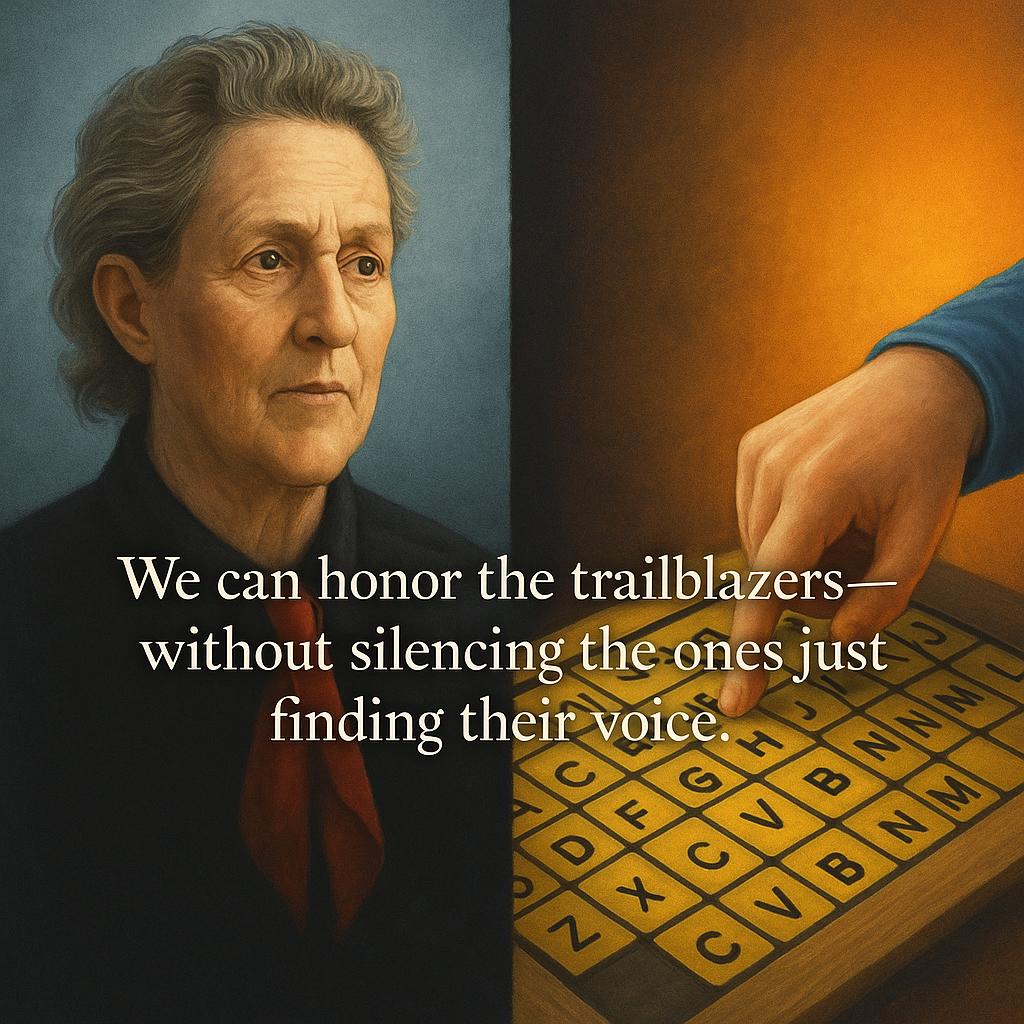
So let’s talk about it.
Not out of outrage. Not to “cancel” anyone. But because this is what real advocacy demands:
* Gratitude for those who’ve blazed trails
* Courage to call out what still needs to change.
What Temple Got Right:
1. Regression Is Real – and Underexplored
Temple drew a critical distinction in the autism community:
“Then you’ve got the other bucket that is regressive. That’s not increased detection – these kids are serious.”
She acknowledged that some children do lose skills. Some stop speaking. Some experience drastic shifts after illness or environmental change.
This matters. Because for too long, any mention of “regression” has been dismissed, politicized, or erased.
Temple reminded us that this subgroup deserves dedicated research and focused inquiry.
2. Autism Is Not an Epidemic – It’s a Definition Problem
Temple called out the elephant in the diagnostic room. The explosion in autism numbers isn’t necessarily due to a real surge in disability – it’s also due to the ever-widening diagnostic criteria.
And she’s right. The term “autism” now captures everything from brilliant, college-bound programmers to children who require 24/7 care and cannot speak. That’s not a spectrum – it’s a galaxy. And while inclusion is important, precision is too. Especially when we’re talking about services, support, and policy.
3. Sensory Trauma Deserves Real Attention
Temple highlighted how sensory overload – like loud bathrooms or flickering lights – can push autistic individuals into a state of chronic fear.
“There are definite abnormalities in the brain scans that show that fear circuits are turned on all the time.”
Yes. Yes. Yes.
This is what so many families live. It’s not defiance. It’s dysregulation. And it deserves more than behavior charts and time-outs. It deserves neuroscience-informed care.
4. A Tactful Approach to RFK Jr.
Temple wisely avoided wading into the political storm around RFK Jr. by stating “no politics.”
But she didn’t shy away from the content of his claims. Instead of fueling the culture war over vaccines, she gently pivoted the conversation toward more grounded, under-researched issues – like regression, environmental triggers, and sensory trauma.
That’s where we should be focused, too.
📰 Read the full NBC article here: https://www.nbcnews.com/politics/trump-administration/autism-national-conversation-temple-grandin-rfk-rcna203641
Where It Falls Short: The Communication Cliff
Temple also commented on the rise of spelling and typing methods used by non-speaking autistic individuals. Her response?
“I’ve got to rule out cuing. That’s the only way, to rule out cuing.”
This is where things get painful.
Because that sentence – short as it is – carries years of dismissal, misrepresentation, and erasure for thousands of families whose kids have finally found a way to communicate. It’s a sentence many of us have heard before. And each time it’s repeated – especially by someone with authority – it reinforces outdated fears and erases what’s already been proven possible.
Temple is referring to old controversies around Facilitated Communication. But what she misses – or doesn’t name – is the science we now have around apraxia, motor planning challenges, and the intentional support many non-speakers require to get their thoughts from brain to letterboard.
Spelling to Communicate (S2C), Rapid Prompting Method (RPM), and related approaches have unlocked real, independently verified communication for kids who were once assumed to be cognitively impaired.
This isn’t fantasy. It’s progress.
And when someone as influential as Temple Grandin casts doubt without context, it can cause real harm.
Families already have to fight tooth and nail for schools, therapists, and systems to even consider spelling-based communication. Comments like hers – even if well-intended – can reinforce barriers and prolong silence.
Where We Go From Here
We still honor Temple.
We still respect what she’s done.
But she doesn’t speak for all autistic people – and she doesn’t get the final word on what’s valid, what’s emerging, or what’s possible.
This moment is calling us to widen the circle of who we listen to.
It’s time to make space for:
* Non-speaking voices
* Families navigating regression
* Kids whose challenges don’t fit the script
You don’t get to talk about autism and leave them out anymore.
This is just Part 1.
In Part 2, we’re going to talk about regression in more depth – why it’s real, why it’s not always about vaccines, and why no one seems to be funding the right research.
Because the truth is: we’ve all been asking the wrong questions.
And the kids can’t wait any longer.
Stay tuned for Part 2:
“What We’re Not Talking About: Regression, PANDAS, and the Real Triggers No One Wants to Study”
I’m trying to understand your position on Facilitated Communication, more specifically S2C Spelling to communicate. I am sure you are aware of the polar opposite websites: facilitatedcommunication.org versus facilitatedcommunication.com? Where’s the proof? Besides one eye tracking study- there is no evidence that states this is a scientific, evidence based?
Scott, if you’re genuinely trying to understand my position, I’ve written extensively about it on my Substack, and I’d encourage you to read some of those pieces.
But I’ll give you the short version. I don’t need a research study to tell me whether my son is capable of communicating. I live his experience every day. His teachers see it every day. He’s taking grade-level high school courses and has a 3.85 GPA. He has demonstrated his knowledge, personality, opinions and abilities in more ways than I could possibly summarize in a comment.
Stone doesn’t have to prove his competence or authorship to me, to you, or to anyone else before his communication deserves to be respected.
I’m also very familiar with the two websites you mentioned. FacilitatedCommunication.com was created as a supportive resource for nonspeakers and families. FacilitatedCommunication.org represents a very different perspective, and the person behind it has served as a paid expert witness in cases involving authorship and facilitated communication. That’s relevant context when evaluating any source, just as my perspective should be understood for what it is.
I’m Stone’s dad.
I’m not claiming to be a neutral observer of my son’s life. I’ve spent 20 years raising him, watching people underestimate him, and then watching many of those assumptions collapse once he gained a means to communicate and demonstrate what he knows.
If you’re interested in understanding how I arrived at my position, my writing lays that out in considerable detail. But I’m not interested in putting my son’s communication on trial every time someone asks me, “Where’s the proof?”