
If I could sit across from you right now — you, the parent who loves a child who doesn’t speak — I would start with this:
You’re not imagining things.
Your child understands far more than anyone has ever acknowledged.
And the systems you’ve been told to trust have been failing you both.
I wish someone had said that to me when Stone was little.
Back then, I kept waiting for the moment when something would finally click — when a therapist would look at him with real curiosity, or when a school would see what I saw. Instead, we spent years trapped in the same loop I know so many of you are still in:
- endless matching tasks
- laminated PEC cards
- “touch the one that matches”
- “look at me”
- “try again”
- reports that said “limited progress”
- and the quiet implication that Stone just wasn’t ready
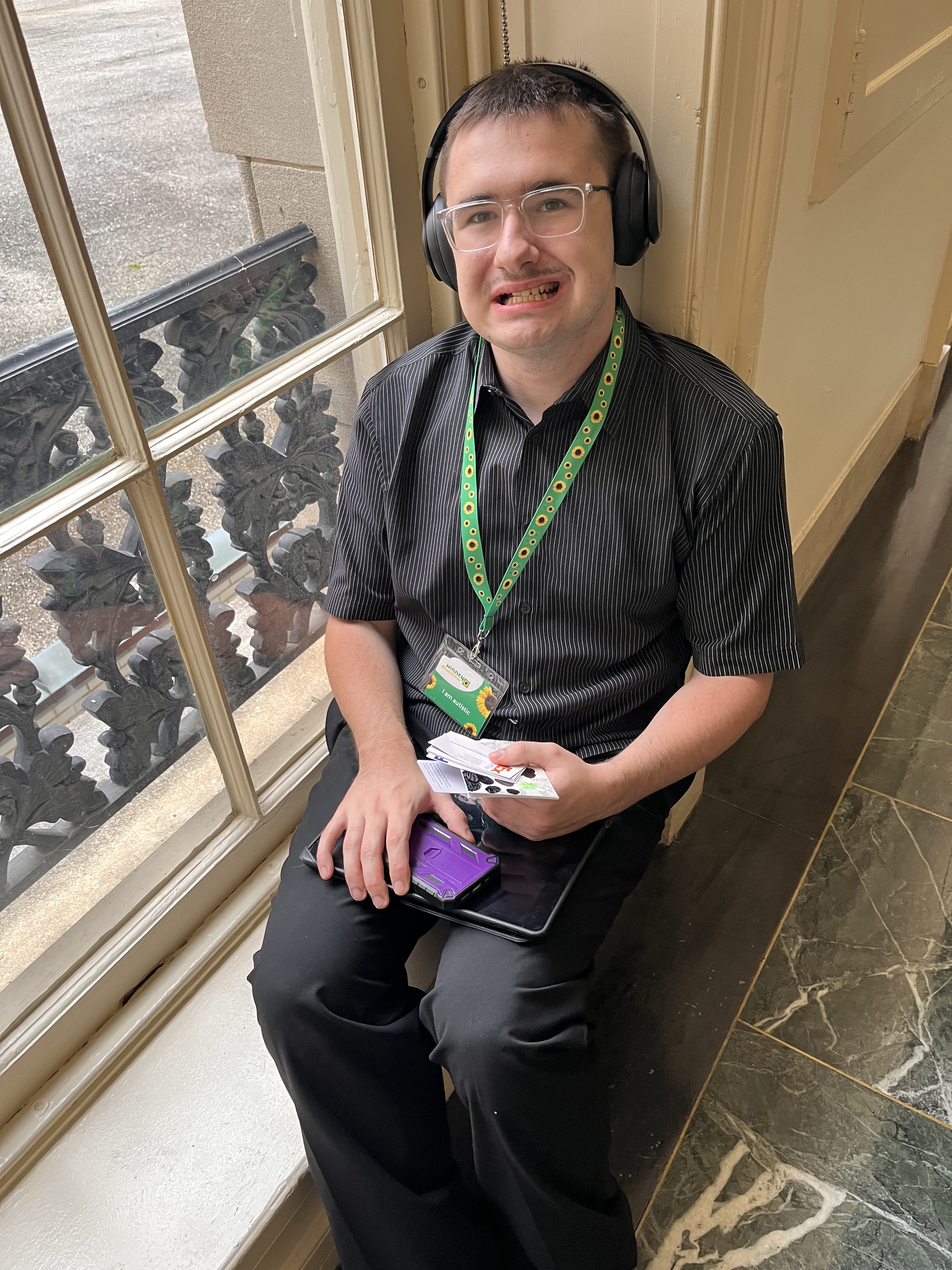
What I didn’t know then — and what I want every parent to know now — is that none of this had anything to do with Stone’s intelligence, or his understanding, or his potential to communicate.
It had everything to do with motor planning.
And no one told us.
When Speech Isn’t the Problem — Motor Planning Is
I wish I could go back and whisper to my younger self:
“David, he hears you. He gets it.
His mind is working beautifully.
His body is where the disconnect is.”
Stone didn’t speak because he couldn’t reliably plan and sequence the movements required for speech. This is called apraxia — and it’s incredibly common among nonspeaking autistic kids.
But we didn’t know that.
Our therapists didn’t know that.
His school definitely didn’t know that.
Instead, they treated speech like a behavior problem.
Or a motivation problem.
Or a readiness problem.
It wasn’t any of those.
It was a motor problem — the same reason many nonspeakers struggle with initiating movement, writing, pointing, eating neatly, dressing themselves, or coordinating their bodies.
No one explained this.
No one even suggested it.
We were left believing the lack of speech meant a lack of understanding.
It didn’t.
Not then, not ever.
The AAC Myth (And Why It Failed Stone Before It Even Began)
Because Stone wasn’t talking, everyone assumed the next logical step was AAC — an iPad with a communication app. This is what speech therapists are trained to recommend. It’s what schools push as their go-to solution. Tech feels modern. Evidence-based. Efficient.
But here’s what no one tells you:
AAC still requires motor planning.
And often more of it than speech.
To say a simple sentence on an AAC device, your child must:
- Initiate a motor plan
- Aim their finger
- Tap the right category
- Tap the subcategory
- Tap the word
That’s five separate motor sequences, executed in order, each requiring accuracy, inhibition, and timing.
If your child has apraxia, that’s like asking someone with a broken ankle to run a relay race.
It’s not that they don’t want to.
It’s that their body won’t cooperate.
Stone’s school believed an AAC system would be “enough.” They even told us that giving him an app to request items would qualify as communication support.
But here’s the truth:
Requesting is not communication.
Navigation is not expression.
Icons are not language.
And they never even tried the device until we began requesting letterboard access.
I want parents to hear this clearly:
Your child is not failing the AAC device.
The device is failing to meet your child’s motor profile.
Why PECS and Matching Didn’t Work — And Never Would
For years, Stone’s SLP relied on PECS and matching tasks.
They insisted he needed to “master” these before moving on.
We waited.
We practiced.
We trusted the process.
Nothing happened.
PECS doesn’t address motor planning.
Matching doesn’t build communication.
And neither one allows a child to express an original thought.
A child can match pictures all day long and still be completely unable to say what they think, feel, or know.
Stone didn’t need more matching.
He needed a way for his intelligent mind to bypass the unreliable pathways of his motor system.
He needed access to language.
To agency.
To his voice.
The Day Everything Changed: 26 Letters
It wasn’t until we discovered spelling — letterboards, open communication systems — that Stone finally broke through.
Here’s the magic no one tells parents:
AAC restricts a child to predetermined words.
A letterboard gives them infinite words.
AAC demands complex motor sequencing.
A letterboard requires one consistent action: point → reset → point.
AAC assumes limited expression.
A letterboard reveals the mind within.
The first time Stone spelled something original, the ground shifted beneath us.
The world rearranged itself.
All the years of “low functioning,”
all the assumptions of cognitive delay,
all the reports that underestimated him —
were replaced by the truth:
He had been there the whole time.
Waiting.
Thinking.
Feeling.
Understanding.
Trapped behind motor challenges no one recognized.
It still breaks my heart to think how long we waited for someone to see him.
I never want another parent to wait that long.
A New Framework: ACC
When Stone began spelling, I realized something that changed everything:
Speech was never the measure of his intelligence.
Motor reliability was.
That’s the foundation of ACC — Autonomous Cognitive Communication.
ACC simply means this:
Your child’s mind is fully there.
Their thoughts are intact.
Their problem is not language —
it’s getting their body to express the language they already have.
ACC reframes nonspeaking autistic individuals not as “low functioning,” “delayed,” or “unable to communicate,” but as:
- cognitively capable
- motor-disconnected
- sensory-overwhelmed
- and profoundly underestimated
It explains why so many nonspeakers thrive when they access tools like letterboards.
It explains why AAC often doesn’t work.
It explains why scripts come out but original speech doesn’t.
It explains Stone’s entire childhood in one sentence.
And more than anything, it returns dignity to kids like Stone — kids who have been treated as less-than for far too long.
A global movement is growing around this understanding.
A movement led by nonspeakers themselves.
If you want to explore it, here are three places to start:
I-ASC (International Association for Spelling as Communication)
🔗 https://i-asc.org
Communication 4 All
🔗 https://communication4all.org
Helios Rising
🔗 https://www.helios-rising.org
These are the communities I wish I had known about 15 years ago.
The communities that would have helped me understand Stone sooner.
And the communities that are now rewriting the future for kids like ours.